The future is wild. Things can just exist because we want them to. It's still hard for me to wrap my brain around.
Content Preview
My son Charlie has a big psychology test coming up, with a ton of stuff to study. I took pics of his notes and gave them to Opus 4.6, and in like 20 mins I had
this
. It has gamification, timed tests, spaced repetition, achievements, matching, fill in the blank, etc., all from 20 minutes and maybe five prompts.
The future is wild. Things can just exist because we want them to. It’s still hard for me to wrap my brain around.
We’ve entered the era of truly bespoke apps, where we generate our own personalized apps in the same way that we generate a playlist on Spotify instead of everyone listening to the same radio stations.
The scary part is that I only made this because Charlie complained about a studying app he found that starts charging money once you reach 10 flashcards. That business will die soon, along with countless others like it that can now be replaced with a few prompts.
An organization’s culture is made up of its folklore (the stories that people frequently tell that indicate what is most important), its rituals (such as how new employees are welcomed into the company), its group norms (including styles of deference and dress codes), and its meeting protocols (like modes of problem solving and decision making). All of these cultural ingredients influence the organization’s adaptability.
Unlike structures, the culture of an organization is not usually written down or formally documented, so it may be hard to describe in precise terms. But like structures, culture still powerfully determines what is considered acceptable and unacceptable behavior.
To break of the monotony of a home office, I work from a Panera (coffee shop and restaurant) most days and take advantage of the Unlimited Sip Club. A couple years ago, I had an interaction that I still think about all the time so I finally decided to write it down.
Content Preview
To break of the monotony of a home office, I work from a Panera (coffee shop and restaurant) most days and take advantage of the
Unlimited Sip Club
. A couple years ago, I had an interaction that I still think about all the time so I finally decided to write it down.
I was waiting at the coffee stand and the guy ahead of me had a rough and tough Ron Swanson vibe about him. After he put the lid on his cup, I saw him take out a pocket knife and carve an opening slot on the side of the lid opposite the spout for air to go through when he drinks.
I said something stupid like “hey, that’s a cool trick.” He turned around and looked me square in the eye for a second like he was sizing me up. Then he said, “I control the flow, the flow doesn’t control me” and he turned and walked out of my life.
Last week I shipped the Kanban board I've always wanted for retros and other structured discussions but never could find time to build myself
Content Preview
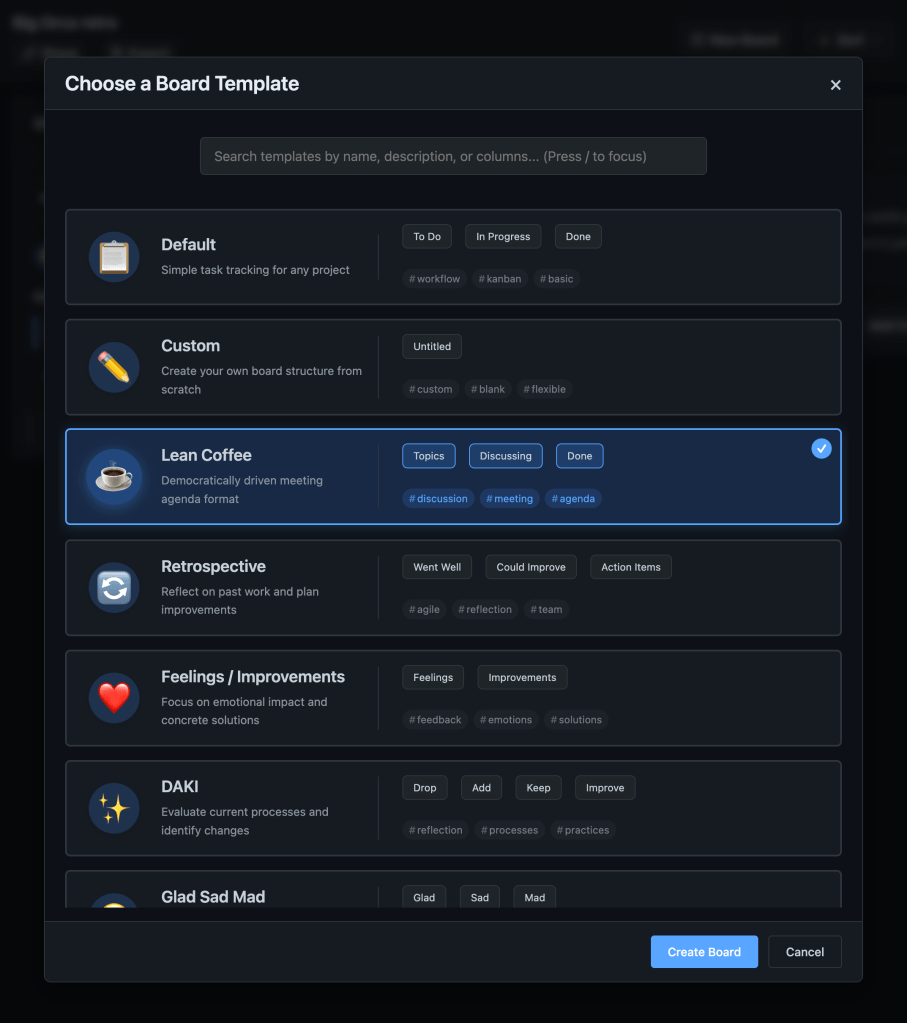
Last week I shipped the Kanban board I’ve always wanted for retros and other structured discussions:
https://www.kanbanish.com/
Features I wanted and couldn’t find all together on any other apps:
No signups required
Anyone can edit anything
Comments, voting, emoji reactions
The ability to vote multiple times on the same card (useful for Lean Coffee)
A bunch of templates for common retro/discussion formats
Export the board contents to plain text or markdown for meeting notes
Let me know if you try it out and have any feedback or notice any bugs!
Online shopping for stuff you don’t absolutely need
Playing whatever the latest popular mindless game is
Everyone knows that stuff is dangerous. But the more interesting examples are the ones that are more unique. For me, it’s stuff like
checking Slack every 30 seconds
and clearing all the unreads, or fiddling with my
todo list settings
. That seemingly-productive-but-not-really stuff gives me a dopamine hit I didn’t work for.
Good dopamine hits should come after
some effort
: finishing a hard workout,
writing something
and sharing it, seeing the view at the summit of a hike, building pretty much anything.
What dopamine hits are you getting without putting in the work?
Anything related to
the weekend
. “Anyone have any fun weekend plans?” and “Anyone do anything fun last weekend?” are the two of the three heads of Cerberus, standing guard at the entrance to small talk hell. Most people don’t know about their own weekends and
don’t care
about anyone else’s. These questions usually create a pregnant pause begging to be filled with “alrighty, let’s go ahead and get things started here.”
Anything related to
the weather
, unless someone’s in the middle of a once-in-a-decade weather phenomenon. Talk of weather only leads to more talk of weather, and nobody wants to know that it’s colder than it ought to be in March. (This is the third head of Cerberus, if that was bugging you.)
The goal is to start an interesting conversation. In general, any topic you can bring up every week (like weekend plans or weather updates) should be avoided.
A few random examples from real meetings I’ve had in the past couple weeks:
Someone wrote in the zoom chat that they were off camera while making breakfast, so I asked if they’re a milk and cereal kind of person or if they’re actually up cooking every day like a weirdo. That led to a fun chat about the
appropriate amount of eggs
to eat (my answer: however many you can hold in one hand) and what egg toppings are acceptable vs. heresy.
Someone had a Rubik’s cube behind them that I hadn’t seen before, so I asked if that was decorative or if they could solve it. The group then spent a few minutes talking about how to
keep your hands busy
on calls and how our kids are better at things than we are.
When zoom opened, I had the classic “oh crap, first meeting of the day and my hair is a wreck but I can’t fiddle with it without everyone seeing me” conundrum. So I just said that out loud and it was so relatable that everyone jumped in. We talked through various strategies: emergency hats on standby, apps that show you on webcam before opening zoom (
Raycast
now supports this!), and going bald.
It's been a while since I've done any serious thinking about myself. Lately I've felt like I've been going through the motions and lacking much purpose or excitement. So it seemed like a good time to figure out what I value these days.
Content Preview
It’s been a while since I’ve done any serious thinking about myself. Lately I’ve felt like I’ve been going through the motions and lacking much purpose or excitement. So it seemed like a good time to figure out what I value these days.
I spent some time with some dumb online quizzes and some time with my therapist (i.e., ChatGPT) and ended up with this list which I’m pretty happy with:
Health
: Well-being, both physical and mental, that supports everything else.
Belonging
: Social acceptance, popularity, influence, and recognition.
Stability
: Financial security, inner harmony, peace, and predictability.
This is a big departure from my original two (growth and joy), but those stopped serving me like they used to.
So the question now, as always, is: how do I make sure I’m living within these values? Here’s the routine (hey, there’s that predictability and stability!) I’m going to follow. I’ll set up the calendar events now. It’s just a few journaling prompts:
Daily
:
What did I do today to support:
Health
Recognition
Stability
What did I do today to stray from:
Health
Recognition
Stability
Weekly
:
What were my goals from last week and how did they go:
Health
Recognition
Stability
What goals do I went to set for this week:
Health
Recognition
Stability
Quarterly
Health
How successfully are you living within this value (1-5)?
What have you accomplished in the past 3 months?
What should you focus on in the next 3 months?
Recognition
How successfully are you living
within this value
(1-5)?
What have you accomplished in the past 3 months?
What should you focus on in the next 3 months?
Stability
How successfully are you living
within this value
(1-5)?
I've rambled a good bit about whether I'm an introvert or an extrovert. The other day, this test from Scaling People by Claire Hughes Johnson stood out to me.
Content Preview
I’ve
rambled a good bit
about whether I’m an introvert or an extrovert. The other day, this test from
Scaling People
by Claire Hughes Johnson stood out to me:
Once you’ve started to understand your underlying values, it’s time to build awareness of your personal work style and preferences. The most obvious preference is probably whether someone is an introvert or extrovert. Do you gain energy from interactions with others or from quiet reflection on your own?
One of my favorite litmus tests is: Do you talk to think or think to talk?
I want to believe that's true, but the line between "gentle and relaxed" vs. "lazy and apathetic" is not obvious.
Content Preview
I’m finally reading the classic “Don’t Sweat The Small Stuff…And It’s All Small Stuff” by Richard Carlson just because it was there, and this section stood out to me:
Let go of the idea that gentle, relaxed people can’t be superachievers
One of the major reasons so many of us remain hurried, frightened, and competitive, and continue to live life as if it were one giant emergency, is our fear that if we were to become more peaceful and loving, we would suddenly stop achieving our goals. We would become lazy and apathetic.
You can put this fear to rest by realizing that the opposite is actually true. Fearful, frantic thinking takes an enormous amount of energy and drains the creativity and motivation from our lives. When you are fearful or frantic, you literally immobilize yourself from your greatest potential, not to mention enjoyment. Any success that you do have is despite your fear, not because of it.
[…] I have learned the important lesson: When you have what you want (inner peace), you are less distracted by your wants, needs, desires, and concerns. It’s thus easier to concentrate, focus, achieve your goals, and to give back to others.
I want to believe that’s true, but the line between “gentle and relaxed” vs. “lazy and apathetic” is not obvious. I worry about using “I’m being gentle and relaxed” to rationalize not pushing myself to grow.
How can I find both?
Email me
if you have thoughts.

Anything related to the weekend . “Anyone have any fun weekend plans?” and “Anyone do anything fun last weekend?” are the two of the three heads of Cerberus, standing guard at the entrance to small talk hell. Most people don’t know about their own weekends and don’t care about anyone else’s. These questions usually create a pregnant pause begging to be filled with “alrighty, let’s go ahead and get things started here.”